What is a naval blockade and how would it work in Strait of Hormuz?
Donald Trump says that the US is going to start blockading the Strait of Hormuz. What does this mean in practice?
Coverage by Political Leaning
See how different sides of the spectrum reported this story
Notable Quotes
"I have also instructed our Navy to seek and interdict every vessel in International Waters that has paid a toll to Iran."
— Donald Trump , Politician
"Any Iranian who fires at us, or at peaceful vessels, will be BLOWN TO HELL!"
— Donald Trump , Politician
"The UK would not join the US blockade."
— Sir Keir Starmer , Politician
"Effective immediately, the United States Navy, the Finest in the World, will begin the process of BLOCKADING any and all Ships trying to enter, or leave, the Strait of Hormuz."
— Donald Trump , Politician
"No one who pays an illegal toll will have safe passage on the high seas."
— Donald Trump , Politician
"Any Iranian who fires at us, or at peaceful vessels, will be BLOWN TO HELL!"
— Donald Trump , Politician
"the threat that a ship may 'bunk' into sea mines was the only thing Iran had to intimidate them from crossing the strait."
— Donald Trump , Politician
"The United States to Blockade Ships Entering or Exiting Iranian Ports on April 13 at 10:00 A.M. ET."
— Donald Trump , Politician
"The aim is, first, tactical pressure related to the negotiations, which stalled after 21 hours."
— Rasha Al Joundy , Academic
"Under UNCLOS (the United Nations Convention on the Law of the Sea), a blockade is an act of coercion — incompatible with any active ceasefire."
— Abdolreza Alami , Academic
"But when just inches away from Islamabad MoU, we encountered maximalism, shifting goalposts, and blockade."
— Seyed Abbas Araghchi , Politician
"Effective immediately, the United States Navy, the Finest in the World, will begin the process of BLOCKADING any and all Ships trying to enter, or leave, the Strait of Hormuz."
— Donald Trump , Politician
"We leave here with a very simple proposal, a method of understanding that is our final and best offer. We'll see if the Iranians accept it."
— JD Vance , Politician
"As they promised, they better begin the process of getting this INTERNATIONAL WATERWAY OPEN AND FAST!"
— Donald Trump , Politician
"We are fully 'LOCKED AND LOADED.'"
— Donald Trump , Politician
"It's going to be all or none, and that's the way it is."
— Donald Trump , Politician
"I told the Navy to seek and interdict every vessel in International Waters that has paid a toll to Iran."
— Donald Trump , Politician
"If you fight, we will fight."
— Mohammad Bagher Qalibaf , Politician
"Trump's plan to use the Navy to block the strait is unrealistic."
— Andreas Krieg , Academic
"any vessels approaching the blockade would be 'immediately ELIMINATED.'"
— Donald Trump , Politician
"This strictly defensive mission, separate from the warring parties to the conflict, is intended to be deployed as soon as circumstances permit."
— Emmanuel Macron , Politician
"the U.K. is not getting dragged into war with Iran."
— Keir Starmer , Politician
"Effective immediately, the United States Navy, the Finest in the World, will begin the process of BLOCKADING any and all Ships trying to enter, or leave, the Strait of Hormuz."
— Donald Trump , Politician
"THIS IS WORLD EXTORTION."
— Donald Trump , Politician
"I could take out Iran in one day. I could have their entire energy everything, every one of their plants, their electric generating plants, which is a big deal."
— Donald Trump , Politician
"We will not bow to any threats from Washington."
— Mohammad Bagher Ghalibaf , Politician
"The bottom line: This is a big task, and it’s a big gamble."
— James Stavridis , Academic
"The U.S. can implode Iran’s economy by shutting down its oil exports."
— Robin Brooks , Academic
"any Iranian who fires at us, or at peaceful vessels, will be BLOWN TO HELL"
— Donald Trump , Politician
"It’ll be something very similar to that, but at a higher level."
— Donald Trump , Politician
"The US is going to start blockading the Strait of Hormuz."
— Donald Trump , Politician
"Effective immediately, the United States Navy, the Finest in the World, will begin the process of BLOCKADING any and all Ships trying to enter, or leave, the Strait of Hormuz."
— Donald Trump , Politician
"This is a historic opportunity."
— Marco Rubio , Politician
"The global outlook has abruptly darkened following the outbreak of war in the Middle East."
— Pierre-Olivier Gourinchas , Academic
"This would take another 12 percent of global oil flow away from the global markets and it would push up oil prices dramatically."
— Trita Parsi , Academic
"Oil/gas accounts for 80% of [Iran] government export earnings and 23.7% of GDP."
— Miad Maleki , Academic
"The United States Navy, the Finest in the World, will begin the process of BLOCKADING any and all Ships trying to enter, or leave, the Strait of Hormuz."
— Donald Trump , Politician
"despite 'considerable pressure', he would not get 'dragged into the war'."
— Keir Starmer , Politician
"We can't let a country blackmail or extort the world."
— Donald Trump , Politician
"We're not supporting the blockade."
— Keir Starmer , Politician
"Iran will not have a nuclear weapon."
— Donald Trump , Politician
""Effective immediately, the United States Navy, the finest in the world, will begin the process of blockading any and all ships trying to enter, or leave, the Strait of Hormuz.""
— Donald Trump , Politician
""No one who pays an illegal toll will have safe passage on the high seas.""
— Donald Trump , Politician
"the U.S. forcibly seized an Iranian-flagged cargo ship that tried to get around a naval blockade"
— Donald Trump , Politician
Key People
Abbas Araghchi is the Foreign Minister of Iran.
Abdolreza Alami is a senior lecturer at the faculty of communication and media studies at Universiti Teknologi Mara in Malaysia.
Ali Khamenei was the Supreme Leader of Iran until his death.
Andreas Krieg is an associate professor in Security Studies at King’s College London.
Anthony Albanese is the Prime Minister of Australia.
A former senior US diplomat and Middle East negotiator.
Former president of the United States known for his aggressive economic policies.
Emmanuel Macron is the President of France.
James Stavridis is a retired Admiral and former NATO supreme allied commander.
Trump's son-in-law and a special envoy working on Middle Eastern negotiations.
J.D. Vance is a U.S. Senator from Ohio.
JD Vance is a United States Senator from Ohio and a prominent figure in conservative politics.
British Prime Minister and leader of the Labour Party.
Lars Jensen is a shipping analyst from Vespucci Maritime.
U.S. Secretary of State.
Margarita Robles is the Minister of Defense of Spain.
Max Boot is a senior fellow for national security studies at the Council on Foreign Relations.
A former senior US treasury official who has expertise in sanctions against Iran.
An expert commenting on the economic implications of the blockade.
Mohammad Bagher Ghalibaf is the Speaker of the Iranian Parliament.
Speaker of the Iranian parliament and a key figure in the negotiations with the US.
Pierre-Olivier Gourinchas is the chief economist at the International Monetary Fund.
Rasha Al Joundy is a senior researcher at the Dubai Public Policy Research Centre.
Robin Brooks is a senior fellow at the Brookings Institution.
Seyed Abbas Araghchi is Iran's Foreign Minister.
Leader of the Labour Party and Member of Parliament for Holborn and St Pancras.
A special envoy involved in negotiations with Iran.
Trita Parsi is the cofounder of the Quincy Institute for Responsible Statecraft.
Locations
Tags
All Coverage
Donald Trump says that the US is going to start blockading the Strait of Hormuz. What does this mean in practice?
United States President Donald Trump ordered the naval blockade of the Strait of Hormuz after peace talks with Iran in Islamabad failed to yield results. The U.S. Central Command began implementing the blockade, which is enforced impartially against vessels of all nations entering or departing Iranian ports and coastal areas, including all Iranian ports on the Persian Gulf and Gulf of Oman.
President Donald Trump ordered the US Navy to block the crucial Strait of Hormuz shipping lane, furious with Iran’s refusal to surrender its nuclear ambitions after peace talks in Pakistan broke down without an agreement. Iran's Revolutionary Guards warned they had traffic in the strategic waterway under their full control and would trap any enemy who tried to challenge it 'in a deadly vortex'.
The Trump administration imposes a naval blockade of the Strait of Hormuz, betting that Iran will buckle under economic pressure before the global energy crisis forces the U.S. to back down.
The U.S. military announces it will enforce a blockade on all Iranian ports in the Strait of Hormuz after ceasefire talks with Iran end without an agreement.
The U.S. is poised to implement a naval blockade on Iranian ports to pressure Iran into ending hostilities and reopening the Strait of Hormuz, a key global oil transit route. The blockade aims to halt Iran’s oil and gas exports, potentially destabilizing the Iranian economy and weakening its leadership. Analysts are divided on the potential global economic impact.
Several U.S. Navy warships, including the USS Frank E. Peterson and USS Michael Murphy, crossed the Strait of Hormuz on Saturday for the first time since the onset of the war with Iran. This transit follows the recent U.S.-Iran ceasefire agreement, in which reopening the strait was a key element.
President Donald Trump ordered a U.S. naval blockade of the Strait of Hormuz in response to Iran's refusal to give up its nuclear ambitions during peace talks in Islamabad. The blockade aims to prevent ships from entering or leaving the strait and to interdict vessels that have paid transit fees to Iran, as well as to destroy sea mines allegedly deployed by Iran in the waters.
President Donald Trump announced that the U.S. Navy would 'immediately' begin a blockade of ships entering or leaving the Strait of Hormuz, after U.S.-Iran ceasefire talks in Pakistan ended without an agreement. The blockade aims to exert strategic control over the waterway responsible for 20% of global oil shipping before the conflict began.
The U.S.-Iran ceasefire appeared on the brink of collapse as the U.S. prepared to blockade the Strait of Hormuz, a move that marks a sharp military escalation following the collapse of weekend peace talks. The U.S. Navy is set to block shipping traffic in and out of Iranian ports starting at 10 a.m. Eastern Time on Monday.
President Donald Trump announced that the U.S. Navy would immediately impose a blockade on the Strait of Hormuz after ceasefire talks with Iran failed to produce a deal. This move aims to counter Iran's control over the vital waterway by preventing the export of Iranian oil and removing sea mines allegedly placed by Iran.
The U.S. naval blockade aims to pressure Iran by disrupting its oil exports through the Strait of Hormuz, raising concerns about global oil prices and economic stability.
The U.S. Navy begins a blockade of the Strait of Hormuz, aiming to interdict vessels paying tolls to Iran, with potential impacts on global oil prices and maritime security.
Global oil prices surged following the U.S. announcement of a naval blockade on the Strait of Hormuz, a critical passage for global oil trade.
Several Iran-linked and Chinese-linked tankers defied a U.S. Navy blockade in the Strait of Hormuz, undermining President Trump's strategy to pressure Iran following failed peace talks in Islamabad.
President Trump orders a U.S. naval blockade of the Strait of Hormuz after U.S.-Iran peace talks in Pakistan end without an agreement.
President Trump orders a U.S. naval blockade of the Strait of Hormuz in response to Iran's refusal to give up its nuclear ambitions during failed peace talks in Islamabad.
President Trump discusses the U.S. naval blockade in the Strait of Hormuz, emphasizing the need to prevent Iran from 'blackmailing or extorting the world.'
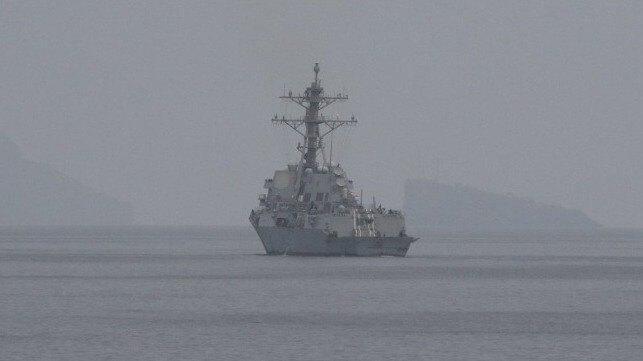
President Trump announces a U.S. blockade of the Strait of Hormuz, doubling the impact of the current Iranian closure.
President Trump announces the U.S. will begin a naval blockade of the Strait of Hormuz following the collapse of high-stakes peace talks with Iran.
US President Donald Trump has announced a sweeping naval operation targeting the Strait of Hormuz, one of the world’s most important oil transit chokepoints, following the collapse of peace talks with Iran.
Tensions have escalated between Iran and the U.S. just days before a planned round of diplomatic talks in Islamabad, Pakistan, jeopardizing hopes for progress. Over the weekend, the U.S. seized an Iranian cargo ship it said was trying to bypass a blockade, prompting Iran to promise retaliation and question the sincerity of upcoming negotiations.
Similar Stories
Related coverage based on topic and tags
Yemeni government forces advance on Bab el-Mandeb Strait - Reuters
Yemeni government forces advance on Bab el-Mandeb Strait Reuters
October 5, 2026 at 11:23 AMAttacks on tankers in Hormuz hit highest of any week since start of Iran war, sources say - Reuters
Attacks on tankers in Hormuz hit highest of any week since start of Iran war, sources say Reuters
October 7, 2026 at 03:24 PMTrump envoy kept financial ties to firm behind $15 billion Hormuz-bypass oil pipeline plan - Reuters
Trump envoy kept financial ties to firm behind $15 billion Hormuz-bypass oil pipeline plan Reuters
October 9, 2026 at 11:40 AMUS imposes fresh sanctions on Iran's shadow fleet - Reuters
US imposes fresh sanctions on Iran's shadow fleet Reuters
October 8, 2026 at 05:25 PMOil falls as Trump comments on Iran talks ease supply concerns - Reuters
Oil falls as Trump comments on Iran talks ease supply concerns Reuters
October 9, 2026 at 02:28 AMTrump says US will not attack Iran before midterm elections in November - Reuters
Trump says US will not attack Iran before midterm elections in November Reuters
October 8, 2026 at 05:22 PM